
Music is a theme running through my novel. Years ago, I was fascinated by the film Swing Kids about young Berliners and their passion for American swing music. Karl, the main character in my novel, could be any one of these fashionable young men coming together to dance and listen to the music of Benny Goodman and others. It is well documented that most POW camps in the UK had a choir. What is not so well known is that some camps had an orchestra. I was fascinated to find this photograph of a fifteen-piece orchestra giving a performance at POW Camp 64, Denny, near my hometown of Falkirk. Unsurprising then, that scenes featuring an orchestra are included in my novel.
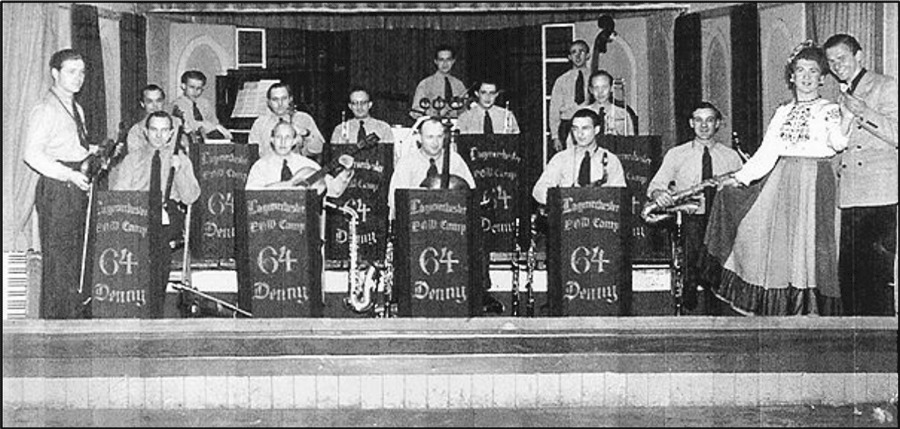
This photograph was taken of the camp musicians in the summer of 1946, barely one year after the war. A number of things struck me about this photograph. There are three saxophones, three clarinets, as well as violins, guitar, cello, double bass, piano, and percussion. How did they obtain the instruments, where did they get music, who arranged it, and who is the young lady pictured with the orchestra? I may never be able to answer any of these questions, but it provided me with some great material. Karl could be the young man sitting at the piano, or perhaps the master of ceremonies with the young female singer.
Music has always been a part of my life. I had piano lessons at an early age and have played the guitar since I was eighteen. But it was my involvement with the gay choral movement in the USA and Canada that instilled in me the power of music to change lives. It might seem incongruous to say there are parallels with the gay choral movement and German POWs. The former had its roots in San Francisco in the aftermath of the AIDS crisis. German POWs were perhaps inaccurately all branded as Nazis, and following the discovery of the death camps, these accusations would have grown. Like the young men in San Francisco, who just wanted to sing for the friends and lovers they lost, so these young Germans would come together and sing. They would sing not just for the uplifting power of music, but to let the British public know they were not the monsters responsible for the Holocaust.
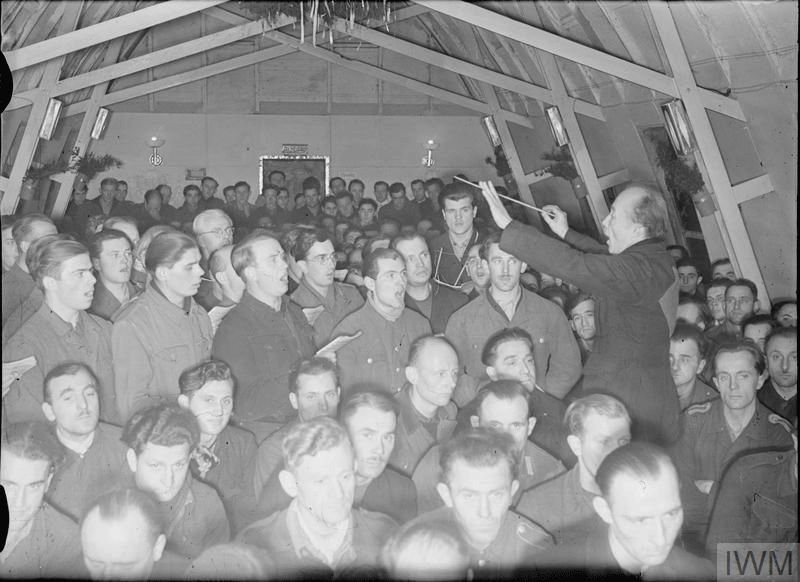
Music, therefore, became a platform for Karl. He had seen his musical aspirations swept away with the rise of the Nazis. With over a thousand POWs in his camp, it would have come as no surprise that among the ranks of these POWs would emerge some fine singers and musicians. I enjoyed this part of the writing. I was able to draw on my choral singing experience and imagine how someone like Karl could be part of forming a choir and orchestra.
Another surprising nugget from my research was finding out that this orchestra (they were known as The German Orchestra of Camp 64) went on to record a single in Glasgow. The camp commandant, a Lieutenant-Colonel Hans Millar (no relation), is credited as the vocalist on this record. I am trying to trace the descendants of Colonel Millar, as well as the lady who sang with the orchestra, a local girl, later identified as Rose McNeill.
***
Writing historical fiction, as any author will confirm, requires extensive research. This is essential to ensure authenticity. This includes everything from the weather on D-Day to what cars people drove, to what they ate. One of the more challenging aspects of my novel was to understand how POW camps in Britain were organized and what day-to-day life was like for POWs. I delve more into this in my next newsletter.