
Welcome to my website and to the first of my monthly newsletters. With the website launch, I am including three separate newsletters, but moving forward, these will be posted monthly. As a subscriber, what can you expect to read? Basically, each newsletter will have the following elements:
- The Book – background, progress, editing, facts, character development, and settings.
- Faces, Places, and Changes – My MFA course, move to Scotland, people.
- Stories and Scribbles – Books I’ve read, writing community, and future writing.
- Curmudgeon Chronicles – a light-hearted commentary from a 70-year-old first-time writer.
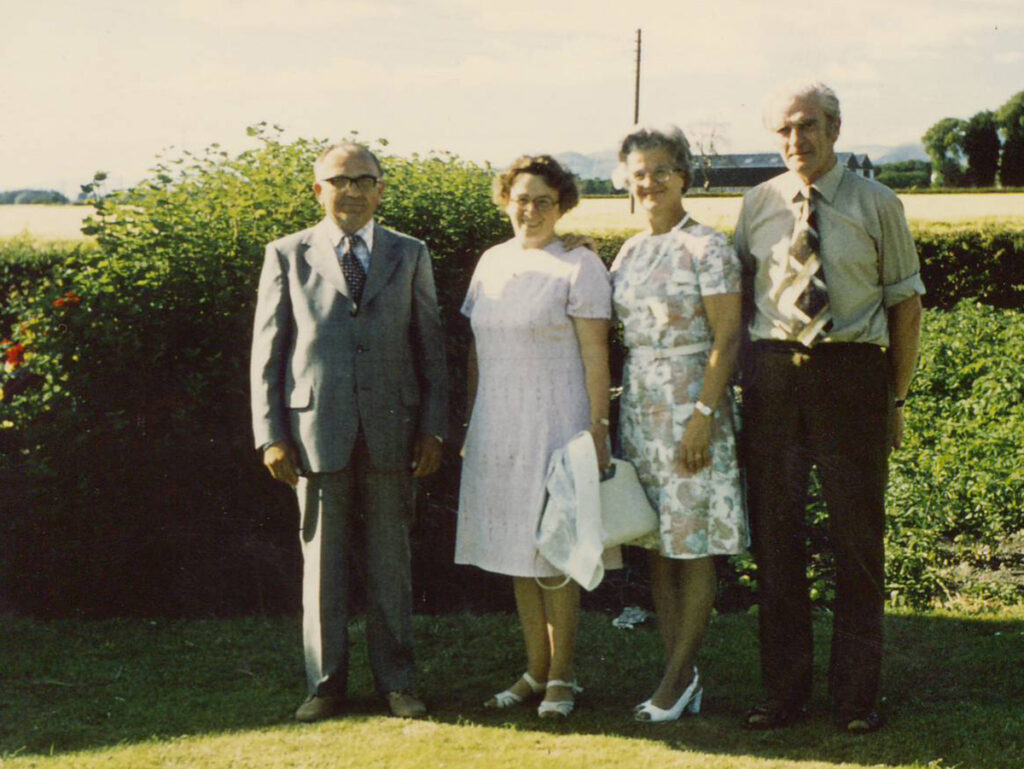
What is the origin of my novel about a German prisoner of war? Writers find their inspiration in photographs or in stories shared around the kitchen table. As youngsters, we’d been told of this former POW, called Wilfrid, who worked on the family farm during and after the Second World War. After repatriation back to Germany, he sent a Christmas card every year. It was, therefore, a moment of discovery when Wilfrid and his wife came back to Scotland one summer in the early 1980s to visit us, and also revisit what was left of Camp 64, near my hometown of Falkirk. The photograph shows, left to right, Wilfrid, his wife, and my parents, Margaret and Tom Millar.
I was in my early twenties when Wilfried came to visit, but this has lingered in my mind ever since. It wasn’t just the visit that captured my imagination: it was also stories from my parents. Our dad told us of the adventures he and Wilfrid had around the farm, such as fixing up old motorbikes and riding them around the fields. My mother was a nurse during the war and told us stories of looking after German POWs in the Falkirk hospital. She remembered one Christmas Eve, going into the ward and seeing the POWs sitting around a candle and singing Stille Nacht. It was through such stories I began to wonder about these German POWs—most of whom had no love for Hitler—and what their lives were like during captivity.
POWs were generally treated well, and they discovered freedoms denied to them in Germany. They were able to read newspapers and listen to the BBC radio broadcasts. Ironically, they became an asset for the British war effort in helping offset the huge labour shortage, especially in agriculture. In the years after the war, there were 400,000 German POWs in the UK. This was the population of Scotland’s capital city, Edinburgh. And yet, very little is known about the impact they had on the country. Who were they, and what were their lives like?
The principal character of my novel, Karl, bears little resemblance to the real-life Wilfrid. For my novel, I imagined what life would have been like for a young man growing up in 1930s Berlin, someone who had a free spirit and loved American jazz and swing. How would such a person adjust to life in a Scottish POW camp after five years in Hitler’s army? As a musician, would there be opportunities for him to pursue music? How would he adapt to working on a farm, as well as the growing friendship between him and Iain, the handsome young farmer’s son? This, then, became the background for my story.
***
A theme running through my novel is the importance and transformative effect of music in the lives of POWs. In my next newsletter, this is developed extensively.